- President's Message
- Data Centers
- List of Helen Franke Society
- NEWI Video Interview
|
- Property Taxes
- Political Labels
- Committee Shorts
- New LWVCC Members
|
|
- Primary Analysis
- Be Part of Something Enduring
- Key Election Dates
|
|

PRESIDENT's MESSAGE
Register, Register, Register!
|
|
I’ve been listening to and reading about reflections on the primary
election. It's never been more apparent that the League of Women Voters'
work to help get voters registered is critical. And after they are
registered, to get them to vote. In Florida, just a little more than a quarter
of eligible voters voted in the Primary.
September is Voter Registration Month. I challenge you to find three
people and encourage them to register to vote. A small number of people
are making decisions for all of us. We can expect a higher turnout for
the General Election in November, as is tradition.
But now is the time to register voters well before our 2028
presidential election.
Shout-out to Voter Services Chair Tina Palmese and her wonderful
committee for doing such an incredible job this year. Collier County
turnout was higher than the State’s.
|
| <

|
Property Taxes:
What's at Stake?
|
|
By Diana Walsh
|
|
Florida voters will decide Amendment 3 on November 3, 2026.
The proposed constitutional amendment would significantly increase the
homestead exemption while reducing property tax revenue available to local
governments. It requires 60% voter approval to pass.
If approved, Amendment 3 would:
-
Increase the homestead exemption for
non-school property taxes to as much as
$150,000 in 2027 and $250,000 in 2028.
-
Reduce the annual assessment increase cap on
non-homestead property from 10% to 5%.
The annual increase cap for homesteaded property would remain
at 3% or CPI.
-
Phase in the increased exemption for people establishing a Florida
homestead beginning in 2027; they would become eligible for the
larger exemption beginning in their fifth year.
-
Limit the purposes for which counties and municipalities may use
property tax revenue, introducing new controls for how local
communities use tax revenue.
-
Leave the existing $25,000 exemption for school district
property taxes unchanged.
The proposal could substantially reduce local government revenue.
State economists estimate statewide property tax revenue losses of
approximately $5 billion in fiscal year 2027-28,
increasing to nearly $12 billion annually by 2031-32.
In Collier County, property taxes help fund public safety, roads and
infrastructure, parks and beaches, libraries, environmental programs,
public facilities and constitutional offices. Local officials could
respond to reduced revenue by cutting spending or services, increasing
fees or other revenues, adjusting millage rates where permitted, or
using a combination of approaches.
Supporters emphasize tax relief for homeowners and government spending
restraint. Opponents emphasize potential reductions in local services
or the shift to other taxes and fees. The LWV of Florida opposes this
measure, along with 40 other organizations, departments, and non-profits.
The ballot language was rewritten following a court order and is
undergoing further judicial review; final language will be confirmed
by early September.
Read More about Amendment 3
|
| <
 |
Overview of August Primary
|
|
By Stacy Vermylen |
|
The results of the August 18th Primary Election have been certified, and the results were disappointing, with turnout at levels lower than hoped. The detailed demographic and party statistics are not yet available. Here are some highlights and estimations based on the limited data available:
-
Voter turnout declined to 26.4%. The most recent mid-cycle year primary election turnout was 29.8% (2022).
- The number of voters who participated in the Primary declined by 7% despite a 5% growth in the number of eligible voters vs 2022.
- Fewer voters used absentee ballots. 44% of ballots cast were by mail, lower than in 2022 (54.2%). Was this due to the effects of the new requirement to re-request a ballot, uncertainty about absentee voting, or a reflection of the races on this year's ballot? Maybe all of these?
- A higher level of Democrat use of mail ballots was again evident. Using the Governor's race as an indicator, 54% of voters for the Democratic race for Governor voted by mail, vs 38% of Republicans. Both parties were less like to use vote-by-mail than in 2022.
- Turnout (at least measured by the gubernatorial race) was higher for Republicans than Democrats, echoing 2022. For this race, 28.6% of registered Democrats cast a vote for governor, while 32% of registered Republicans voted.
The full data about the 2026 Primary, including vote totals by party, race, and sex, will be available mid September and the October Voter will include a more detailed analysis.
|
|

Data Centers in
Collier County
|
|
By Lynn Martin
|
|
On July 28, 2026, the Collier County Board of County Commissioners unanimously
approved a “zoning in progress” measure addressing large-scale data centers.
The action follows public concern about the potential development of these
facilities and gives the county time to establish regulations before applications
are submitted.
Rather than adopting a formal one-year moratorium, commissioners chose “zoning
in progress,” which allows the county to pause acceptance and processing of new
data center applications while regulations are developed. Although there are
currently no active applications, commissioners said they want clear rules in
place before developers propose projects.
County staff will first define what constitutes a data center, with particular
attention to large “hyperscale” facilities. Regulations are expected to address
important issues including land use, electricity consumption and water
usage. Data centers may ultimately be classified as conditional uses,
requiring public hearings and additional review.
Over the next 12 months, county staff will develop a proposed regulatory
framework. It is expected to be reviewed by the Development Services Advisory
Committee, Planning Commission and Board of County Commissioners before final
adoption.
There will be opportunities for public comment throughout the process. The
LWV Environmental Affairs Committee will also provide educational
opportunities to help League members better understand the potential environmental
impacts of data centers and prepare to participate in the public discussion.
Documents presented to the Planning Commission provide additional information
about the issues under consideration and the county’s approach to developing
appropriate regulations.
Planning Commission Document 1
Planning Commission Document 2
|
|
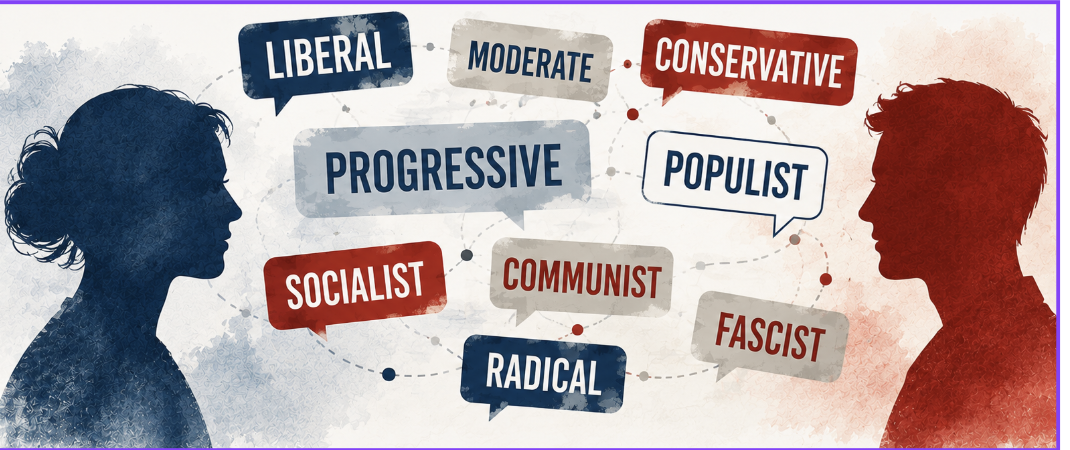
Political Labels: Informative or Destructive?
By MaryJo Diegel and Stacy Vermylen
Shakespeare famously asked, “What’s in a name?” In politics, labels can help us understand the beliefs of individuals and groups. Words such as liberal, conservative, progressive, socialist, and populist provide useful shorthand for political philosophies.
But labels can also mislead. Used inaccurately or to discredit those with whom we disagree, they can contribute to distrust and polarization.
What Do Political Labels Mean?
Many familiar labels have histories more complicated than their modern usage.
Liberal generally describes those who favor an active government role in addressing social and economic problems and protecting individual rights. Conservative traditionally emphasizes limited government, individual responsibility, established institutions, and caution about rapid change. Progressive gained prominence during the Progressive Era, when reformers addressed corruption, working conditions, and concentrated economic power.
Socialist describes philosophies favoring greater public or collective control of economic resources. Populist can apply to the political left or right and generally describes movements claiming to represent ordinary people against powerful elites.
When Do Labels Divide Us?
Labels encourage division when they accuse rather than describe. Calling virtually any government program “socialism,” for example, ignores important distinctions among political and economic systems.
Likewise, fascism has a specific historical meaning involving authoritarian rule, extreme nationalism, suppression of opposition, and rejection of democratic institutions. Using the term simply to disparage a politician or policy diminishes its meaning and encourages discord.
Using Labels Mindfully
Before applying a political label, ask: What does the term actually mean? Does it accurately describe the beliefs or policies in question? Are we using it to understand—or to divide?
Political labels are useful when they inform. When they distort, they divide. Using them accurately encourages informed discussion, greater understanding, and healthier democratic debate.
|
Be Part of Something Enduring
By Suzanne Low
In 2023, LWVCC established its Endowment Fund to help secure the League’s future and provide resources to meet unexpected challenges and new opportunities. Today, with voting rights and voter education more important than ever, that investment in our future is especially meaningful.
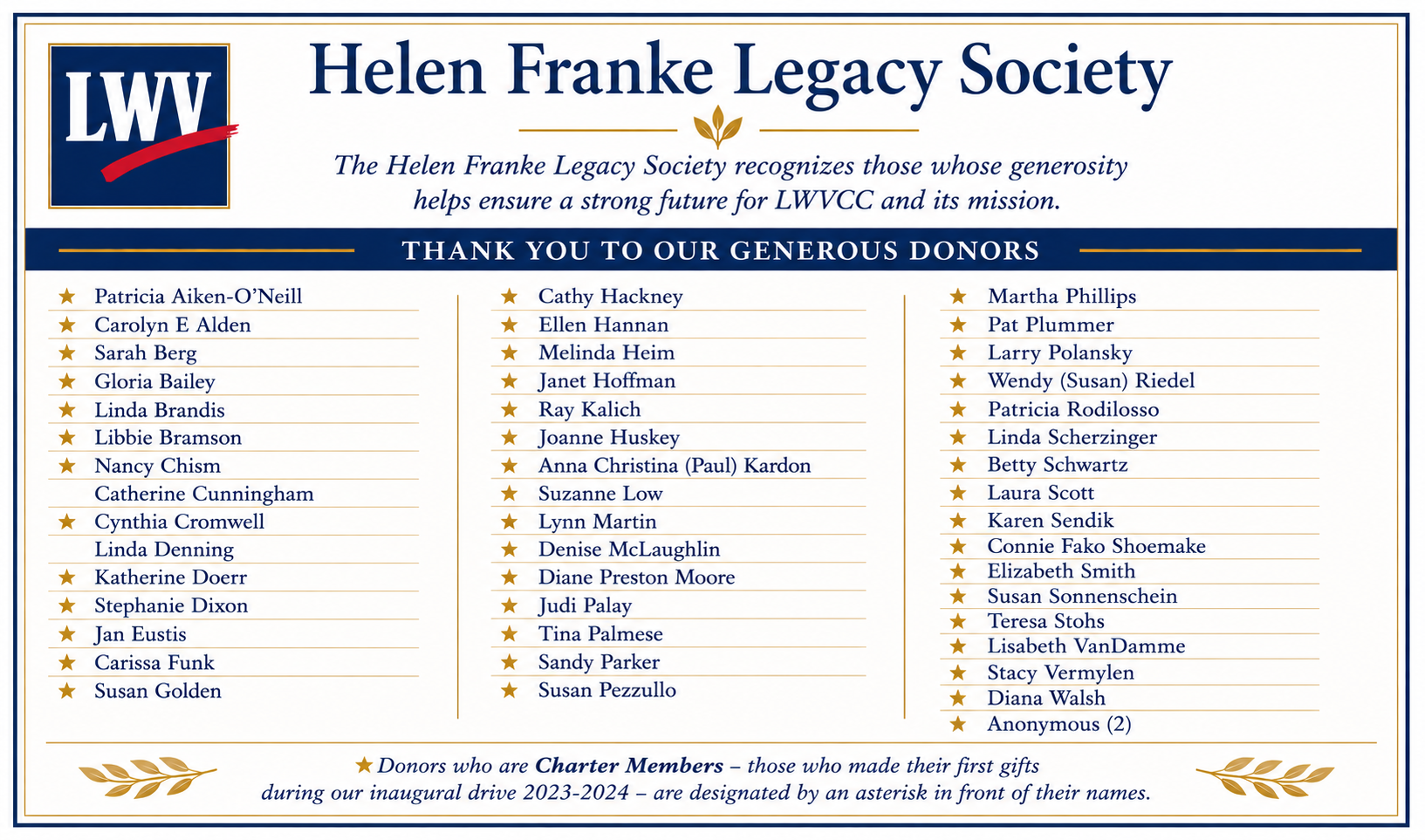
In just three years, the Endowment has grown to more than $81,000, thanks to the generosity of nearly 50 League members.
The Helen Franke Legacy Society, named for the former LWVCC president whose original gift inspired the Endowment, recognizes those who have contributed to this lasting investment in our League.
We invite you to join them in helping ensure that LWVCC can continue defending democracy and educating voters for generations to come. Tax-deductible gifts may be made through the League website or by check to LWVCC, PO Box 9883, Naples, FL 34101. For information, contact Endowment@lwvcolliercounty.org.
|  |
|
Committee Shorts
|
|
Voter Services
There are several opportunities for members to volunteer to help
encourage voter registration, update registrations, request mail
ballots, and share information about candidates and amendments.
Contact Voter Services Chair Tina Palmese at
tpalmese@aol.com
to learn more.
Education Ambassadors
Letter to the Editor submitted by Nancy Chism
Although many Florida voters breathed a sigh of relief when the proposed
property tax rollback (now Amendment 3) was written to exempt school
taxes from any decrease, it is important to note that schools will
indeed be impacted, should the ballot issue pass.
Beyond the allocation that our district, Collier County Public Schools,
receives annually from the state, the district partners with many other
local organizations to provide education to its students and other
benefits to the community. These partner organizations that are funded
by property taxes will have to look for ways to cut their services when
their budgets are reduced.
The services now provided to school districts across the state support
student safety, mental health programs, arts enrichment, health and
wellness programs, before- and after-school childcare, and recreational
initiatives. County-supported organizations like the public libraries
and nutritional services augment student needs out of school. Should
these programs experience drastic budget cuts, their ability to partner
with schools will be jeopardized. School districts may also have to pay
higher fees for services or other purchases if organizations institute
increases to balance their budgets.
The League of Women Voters of Florida opposes passage of Amendment 3.
Voters contemplating supporting the Amendment because it exempts school
taxes need to recognize that schools will be impacted as well as other
essential services, should the ballot issue pass.
|
|

We’re introducing a new way for members to get behind the scenes at LWVCC and learn more about the important work of our committees and teams.
Each month, we’ll sit down with a different committee or team chair for a brief conversation about what they’re working on, why it matters, and how their team efforts support LWVCC’s mission.
We’re kicking off the series this month with Tina Palmese, Chair of Voter Services. Meet Tina and hear what Voter Services is doing to inform, engage and empower Collier County voters.
Click Here to Watch Interview
| Welcome New Members!
Nancy Cohen Linda Urda
|

P.O. Box 9883, Naples, FL 34101 | lwvcolliercounty.org
| |